

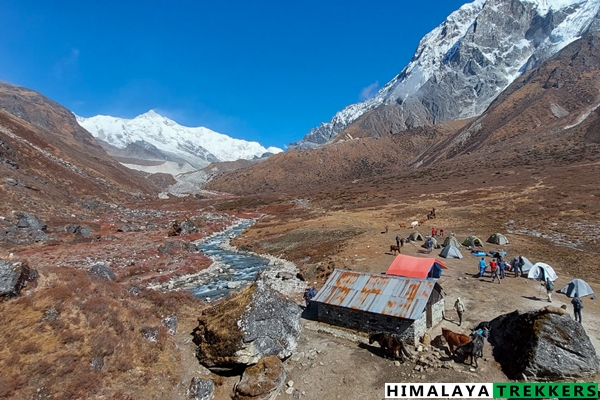
5 friends from UK contacted us early in 2025 for two back-to-back Sikkim treks in November. All very fit and strong, they wanted both cultural immersion through the Sikkim Monastery Trail and a proper high-altitude challenge at Goecha La. Flying from England with about two weeks available, they had questions about sequencing, whether to join a group departure or go fully private, and how to use the monastery trek as preparation for the altitude ahead.
Over several email exchanges, we worked out a hybrid plan: a 5-day private Monastery Trail (November 9-13) with extended pace for acclimatisation prep, followed by a 2-day gap, then joining our last November group departure for the 10-day Goecha La trek (November 15-24). One friend would join only for the cultural circuit, making it 5 people for the Monastery Trail and 4 for Goecha La. The sequencing mattered – starting with lower elevation cultural trekking before the high camps made both physiological and logistical sense. They also requested individual tents rather than standard twin sharing.
The treks went ahead as planned in November 2025. According to post-trek review, “The team was amazing and lovely, always making sure we were safe and very well fed… I doubt you could find a better way to do it.” Here’s how the planning unfolded, and why this cultural-to-altitude sequencing works well for fit trekkers wanting to maximise their Sikkim experience.
Trek Planning Summary: At a Glance
Treks Planned: Sikkim Monastery Trail (private) + Goecha La Trek (group departure)
Dates: November 9-24, 2025 (15 days total)
Group Size: 5 people (Monastery Trail), 4 people (Goecha La)
Origin: United Kingdom (flying into Bagdogra)
Key Requests: Individual tents, extended pace for Goecha La preparation, 2-day buffer between treks
Client Profile
- Team Size: 5 friends from England
- Fitness Level: Very fit and strong (self-described)
- Trek Experience: High-altitude experience queried by HT – have they slept above 4,000m before?
- Booking Preference: Explored both group departure and private custom options to optimise cost
- Special Requests: Individual tent for each person (willing to carry extra tents themselves), extended pace/distances for altitude preparation
Core Requirements
- Two distinct Sikkim experiences: cultural immersion (Monastery Trail) and high-altitude challenge (Goecha La)
- November timing, earliest possible start November 5
- Individual tent accommodation (not standard twin sharing)
- Time buffer between treks for rest and preparation (ideally 2 days)
- Extended pace on Monastery Trail specifically to prepare for Goecha La altitude
- Cost-effective booking: Mix of private (Monastery) and group departure (Goecha La) if possible
Trek Sequencing Decision
Initial Inquiry: Two treks requested with no specific order mentioned – “We would like to do the Goecha La Trek and the Sikkim monastery circuit trek”
HT Recommendation: “You may start with the Sikkim Monastery circuit, get a feel of the area and then embark on your Goechala trek.”
Rationale Behind This Sequencing:
- Acclimatisation: Monastery Trail operates at 1,700-2,400m elevation range, providing gradual altitude exposure before Goecha La’s high camps reach 4,600m. Five days of moderate elevation trekking prepares the body for sustained effort at altitude.
- Cultural Context: Understanding Sikkim’s Buddhist monasteries, village life, and the cultural significance of peaks like Khangchendzonga adds meaning to the high-altitude landscapes encountered later on Goecha La. You’re not just looking at mountains – you understand their spiritual importance.
- Logistical Flow: Both treks start and end at Yuksom. No backtracking to different regions. Gear can be stored at Yuksom homestay during the Monastery Trail, ready for immediate use when Goecha La departure begins.
- Weather Timing: November high camps get progressively colder. Better to complete Goecha La by late November rather than push into December when conditions become significantly harsher.
- Physical Preparation: Multi-day hiking with loaded packs (even light ones) through varied terrain conditions the legs, lungs, and mental stamina before committing to 8 consecutive days of high-altitude camping.
Client Response: “I don’t want to add days to the monasteries trek but happy to have pace/distances extended as preparation for the next trek.”
This shows smart planning – they understood the value of preparation but didn’t want unnecessary extra days. The solution: Keep the 5-day Monastery Trail itinerary but extend daily distances and pace to make it more physically demanding.
Group Departure vs Private Trek Decision
Client Question: “I understand you have calculated the price for a custom trip just for us 4. Is it possible to do it as part of a larger group, and if so, what would the cost be?”
This is a common question and shows cost awareness. Group departures are cheaper per person than fully private treks. But not all treks offer both options.
HT Response:
- Sikkim Monastery Trail: “We only run private and customized batches tailored to the preferences and schedule of your group.” No group departures available for this trek – it’s always custom.
- Goecha La Trek: “We do organize group departures.” Group batches available with fixed departure dates.
- November 2025 Goecha La Timeline: “Our November 2025 group departure dates for the Goecha La trek will be finalized and published around next month, March 2025.”
The November Window Narrows:
“We will schedule our last batch for Goecha La Trek for 2025 on 15th of November. That will be our last group tour as it becomes very cold on the high camps later. After mid-November, only private and customised batches for Goecha La Trek.”
This isn’t marketing language. The high camps at Dzongri (3,965m) and Lamuney (4,150m) get genuinely cold by mid-November. December sees heavy snowfall making the trek significantly harder and less safe. The November 15 batch is literally the last group departure before winter conditions set in.
Final Booking Decision: Private Monastery Trail (November 9-13) + Group Departure Goecha La (November 15-24)
Why This Hybrid Booking Model Works:
- Cost Optimisation: Group departure pricing on Goecha La (the longer, more expensive trek of 10 days) while maintaining flexibility on the shorter Monastery Trail.
- Schedule Flexibility: Private Monastery Trail accommodates their specific start date (Nov 9), custom pace requirements, and allows for 5 people instead of the 4 who’ll do Goecha La.
- Social Aspect: Meeting other trekkers during the Goecha La group departure adds a social dimension during the challenging high-altitude section. Shared experiences at altitude create bonds.
- Buffer Integration: The 2-day gap between treks (Nov 13 end, Nov 15 start) fits naturally with the group departure fixed date. No awkward timing compromises.
Final Itinerary: Sikkim Monastery Trail (Private)
Dates: November 9-13, 2025 (5 days)
Group Size: 5 people
Accommodation: Homestays throughout
Elevation Range: 1,700m (Yuksom) to 2,400m (Kongri)
Special Modification: Extended pace and distances for altitude preparation
Day 1 (November 9): Reach NJP/Bagdogra airport (latest by 10am) and drive to Khecheopalri village via Jorethang and Pelling – 150km, 7-8 hours. Homestay accommodation. This is a long drive day but necessary to reach the trek starting region.
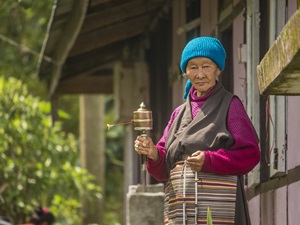
Day 2: Hike to Yuksom, approximately 4-5 hours. In the afternoon, visit Kathok Lake, Coronation site (where the first Chogyal of Sikkim was crowned in 1642), and the local monastery at Yuksom. Homestay. This is a half-day trek with cultural immersion in the afternoon.
Day 3: Trek to Kongri via Dubdi monastery (oldest monastery in Sikkim, built 1701), Tsong village, Hongri, Pokhri Dara – 7-8 hours. Accommodation in basic homestay. This is the longest trekking day of the monastery circuit with sustained uphill.
Day 4: Descend to Tashiding monastery (holiest monastery in Sikkim) – 5 hours. Homestay. Mostly downhill but still requires 5 hours of trekking. Tashiding’s spiritual significance makes this a highlight.
Day 5 (November 13): End of tour. Drive back to Yuksom – 25km, 1.5 hours. Optional visit to Pelling (approximately 40km, 2 hours) to spend a day sightseeing. Most groups return directly to Yuksom to rest before Goecha La.
Final Itinerary: Goecha La Trek (Group Departure)
Dates: November 15-24, 2025 (10 days)
Group Size: 4 people from UK group + other trekkers in the batch
Accommodation: Camping (twin sharing tents upgraded to individual tents) + homestay bookends
Maximum Altitude: 4,600m (15,100 ft) at Goecha La Viewpoint 1
Trek Type: High-altitude camping trek with one acclimatisation rest day
Day 1 (November 15): Reach Yuksom (approximately 1,710m / 5,600 ft). In the evening, guide meets and briefs the whole team about the trek ahead, weather conditions, and safety protocols. Homestay. This is essentially a rest and preparation day.
Day 2: Trek to Sachen (approximately 2,200m / 7,215 ft) – 8km, 4 hours. A half-day hike to ease into the trek. Camp (individual tents as per their request instead of standard twin sharing).
Day 3: Trek to Tsokha (approximately 2,960m / 9,700 ft) via Bakhim – 7km, 4-5 hours. Another half-day climb gaining 760m elevation. The body is starting to adjust to altitude.
Day 4: Trek to Dzongri (approximately 3,965m / 13,005 ft) via Phedang – 12km, 6-7 hours. Challenging day due to sustained climb gaining over 1,000m elevation. This is where altitude starts to be felt. Camp at Dzongri.
Day 5: Rest and active acclimatisation day at Dzongri. Sunrise views from Dzongri top (approximately 4,120m) and back, 2 hours. This is not a lazy rest day – the morning climb to Dzongri top helps acclimatisation through the “climb high, sleep low” principle. Camp at Dzongri.
Day 6: Dzongri to Lamuney (approximately 4,150m / 13,700 ft) via Thangsing – 14km, 7-8 hours. A moderate day in terms of elevation gain but long in distance. You’re now at serious altitude.
Day 7: Trek to Goecha La (Viewpoint 1, approximately 4,600m / 15,100 ft) and back to Kokchurang – 16km, 8-9 hours. The summit day. Long and challenging but the views of Khangchendzonga’s south face are the reward. Camp at lower elevation after the climb.
Day 8: Kokchurang to Phedang traverse and then descend to Tsokha – 18km, 6-7 hours. A moderate day, mostly descending. The body feels the relief of lower altitude. Camp at Tsokha.
Day 9: Tsokha to Yuksom – 15km, 5-6 hours. All descent, essentially retracing the route back to civilisation. Lodge or homestay accommodation (twin or triple sharing) – a real roof and proper bed after 8 nights of camping.
Day 10 (November 24): End of tour. Return to NJP or Bagdogra airport by car – 160km, 8-9 hours (reaching by 6pm). This allows catching evening flights out of Bagdogra if needed.
Key Logistics Arranged
Individual Tent Accommodation:
Client Preference: “For the camping, we would like to have a tent each and would be happy to carry extra tents ourselves. Is this OK?”
HT Response: “We can provide individual tents for each of you on additional charges, and if you’re comfortable carrying extra tents yourselves, that is absolutely fine.”
Final Arrangement: Individual tents provided by HT on Goecha La trek (no need for clients to carry extra). This costs more than standard twin sharing but gives everyone their own space after long trekking days – a luxury worth paying for on an 8-night camping trek.
High-Altitude Experience Assessment:
HT asked: “Have you had any high-altitude experience before this (slept above 4000 meters above sea level) either hiking or by car? If yes, then did you face any problems in acclimatisation?”
This isn’t just curiosity. The answer informs:
- Guide briefing about what to watch for (headaches, nausea, sleep quality)
- Pace setting during the trek (slower if no prior experience)
- Contingency planning (extra rest day if someone struggles)
- Medical kit preparation (Diamox availability, oxygen cylinder if needed)
Even very fit trekkers from sea-level countries can struggle at altitude if they’ve never experienced it before. Fitness doesn’t equal acclimatisation capability.
Group Size Flexibility:
Original Plan: 4 people for both treks
Final Booking: “My group will be 5 for the monasteries trek and 4 for the Goecha La trek.”
This flexibility matters. One person wanted the cultural experience but not the altitude challenge. The private Monastery Trail accommodated 5 people easily. The group Goecha La departure proceeded with their 4. No forcing everyone into the same itinerary.
Permit Requirements for Foreign Nationals:
HT shared: “Please check here the details of various permits required in Sikkim for Indians and foreign nationals.”
Sikkim has specific permit requirements, especially for foreign nationals. Protected Area Permits (PAP) are required for Goecha La trek. November timing and UK nationality factored into permit processing timelines. Starting this conversation early in planning ensures no last-minute surprises.
Buffer Days Between Treks:
Client Request: “Ideally, we’d have 2 days gap after it before we start the next.”
Final Schedule:
- November 13 (Friday): Monastery Trek ends, return to Yuksom
- November 14 (Saturday): Full rest day at Yuksom
- November 15 (Sunday): Goecha La Trek begins
What Happens During This Gap:
- Physical rest – muscles recover from 5 days of trekking
- Gear sorting – repack for camping trek, laundry if needed
- Mental reset – digest the cultural experiences before the altitude challenge
- Meet other trekkers – the Goecha La group assembles on Day 1 evening
- Final preparations – check equipment, buy any last-minute items in Yuksom
This isn’t wasted time. It’s essential transition time that makes the second trek more enjoyable and safer.
November Timing Considerations
Why November Works for Sikkim Trekking:
- Post-Monsoon Clear Weather: By November, monsoon rains have ended. Skies are generally clear with excellent visibility.
- Stunning Mountain Views: Pre-winter clarity means the Khangchendzonga range appears crisp and dramatic from Dzongri and Goecha La.
- Comfortable Lower Elevation Temperatures: The Monastery Trail at 1,700-2,400m is pleasant in November – not too hot, not too cold.
- Less Crowded Than October: October is peak season for Sikkim trekking. November sees fewer trekkers, making the experience more peaceful.
November Challenges to Be Aware Of:
- High Camps Get Cold: “Note that the high camps of Dzongri and above will be fairly cold by mid of November.” Temperatures at 4,000m+ can drop well below freezing at night. Proper sleeping bags (rated for -10°C or lower) are essential.
- December Not Recommended: “December is typically not a good time for this trek.” Heavy snowfall begins, making trails difficult and dangerous. Avalanche risk increases.
- Last Group Batch Window: “After mid-November, only private and customised batches for Goecha La Trek.” This isn’t arbitrary – it’s based on years of experience with when conditions become too harsh for group safety management.
HT’s Clear Guidance: “I would recommend to complete the Goecha La trek latest by the end of November.”
The November 15-24 dates captured the optimal window – late enough for post-monsoon clarity, early enough before severe winter cold.
Why This Trek Combination Works
1. Physiological Preparation
The Monastery Trail operates at 1,700-2,400m for 5 days. This provides:
- Gradual altitude exposure (body starts producing more red blood cells)
- Cardiovascular conditioning (multi-day trekking with elevation gain)
- Muscular adaptation (legs adjust to sustained uphill/downhill)
- Sleep at moderate altitude (better than jumping straight to 4,000m camps)
By the time Goecha La begins, the body isn’t starting from zero. It’s already adapted to multi-day trekking and moderate altitude.
2. Cultural Context Enhances Mountain Experience
The Monastery Trail visits:
- Dubdi monastery (1701) – oldest in Sikkim
- Yuksom Coronation site (1642) – where Sikkim’s first king was crowned
- Tashiding monastery – holiest site in Sikkim
- Villages like Tsong, Hongri – real Sikkimese life
When you reach Goecha La viewpoint and see Khangchendzonga’s south face, you understand why it’s sacred to the Lepcha and Bhutia people. You’ve visited the monasteries that face this mountain, met the people who worship it. The mountain isn’t just a geographical feature – it’s spiritually significant. This context makes the Goecha La experience richer.
3. Logistical Efficiency
Both treks start and end at Yuksom (1,710m). The flow is seamless:
- Day 0: Arrive Bagdogra, drive to Khecheopalri (near Yuksom)
- Day 1-5: Monastery Trail, return to Yuksom
- Day 6: Rest at Yuksom
- Day 7-16: Goecha La trek from/to Yuksom
- Day 17: Drive Yuksom to Bagdogra
No backtracking to different regions. No wasted travel days repositioning. Gear storage at Yuksom homestay between treks. Everything flows naturally.
4. Mental Preparation
Easing into Sikkim through homestay trekking before committing to 8 consecutive nights of high-altitude camping is psychologically smart. You get a feel for:
- Terrain types (forest, ridges, villages)
- Local food (what to expect from camp kitchens)
- Weather patterns (how mornings/afternoons/evenings feel)
- Your own response (are you adjusting well? any issues?)
By Day 1 of Goecha La, you’re not anxious about the unknown. You’ve already been trekking in Sikkim for 5 days. You know what to expect.
5. Cost Optimisation Through Hybrid Booking
Group departure pricing on the 10-day Goecha La trek (the longer, more expensive component) saves significant money compared to making it private. The 5-day Monastery Trail being private doesn’t add as much cost since it’s shorter and uses homestays (cheaper than camping logistics).
If the entire 15-day itinerary was private: Higher total cost
If trying to fit both into group departures: Impossible (Monastery Trail doesn’t have group batches)
Hybrid model: Optimises both cost and flexibility
What Makes the November 15 Window Special
November 15, 2025 is the last group departure for Goecha La before winter. This matters because:
After Mid-November, Conditions Change:
- Temperatures at Dzongri (3,965m) drop from cold to severe cold
- Lamuney (4,150m) becomes genuinely harsh for camping
- Goecha La viewpoint (4,600m) sees increased snowfall
- Wind chill factor increases significantly
- Days get shorter (less daylight for the long summit day)
Why Group Batches Stop:
Managing a group of mixed-ability trekkers in severe cold and snow requires more resources, carries more risk, and has lower success rates. Private batches can still operate because they’re customised to experienced trekkers willing to accept harsher conditions. But for general group departures, the cutoff is mid-November.
The Sweet Spot This Trek Captured:
- Monastery Trail Nov 9-13: Still comfortable at lower elevations, beautiful autumn colours
- Goecha La Nov 15-24: Post-monsoon clarity for views, before severe cold sets in
- Reaching Goecha La viewpoint around Nov 21: Maximum visibility, manageable cold
- Descending before month-end: Avoiding the transition into December conditions
Decision-Making Lessons from This Consultation
1. Trek Sequencing Matters for Both Physiology and Experience:
Starting with lower-elevation cultural trekking before high-altitude camping isn’t just safer for acclimatisation – it’s experientially richer. Even very fit trekkers benefit from gradual progression. The alternative (Goecha La first, then Monastery Trail) would feel anticlimactic and miss the acclimatisation benefit.
2. Hybrid Booking (Private + Group) Optimises Multiple Goals:
You don’t have to choose between “fully private” and “fully group.” Mixing both models lets you:
- Save money on the longer trek (group pricing)
- Keep flexibility on the shorter trek (private scheduling)
- Accommodate different group sizes (5 people vs 4 people)
- Get social benefits where they matter (meeting others at altitude)
3. Seasonal Windows Are Real, Not Marketing Speak:
When HT says November 15 is the “last group batch” and December is “not a good time,” that’s based on actual weather data and safety assessment. The window for comfortable Goecha La trekking genuinely closes by late November. Planning around these real windows matters for both safety and enjoyment.
4. Buffer Days Between Treks Have Multiple Functions:
The 2-day gap isn’t just physical rest. It’s:
- Muscle recovery time
- Gear reorganisation time
- Mental transition time
- Social integration time (meeting other Goecha La group members)
- Contingency buffer (if Monastery Trek runs a day late due to weather)
These aren’t wasted days – they’re functional transition time that makes the second trek more successful.
5. Individual Preferences Can Be Accommodated with Early Communication:
Individual tents, extended pace for preparation, one person doing only one trek, specific start dates – all of this flexibility is possible when you communicate requirements early in planning. Last-minute requests are much harder to accommodate. Group asked about individual tents in their first email, making it easy to build into the plan.
Related Treks and Topics
- Sikkim Monastery Trail – Full itinerary and details
- Goecha La Trek – Complete route information
- Dzongri Trek – Shorter alternative (5 days, reaches 4,120m)
- November Trekking in Sikkim: Weather and Conditions
- Acclimatisation Strategies for Himalayan High-Altitude Treks
- Group Departure vs Private Trek: Which Should You Choose?
Below follows the complete email consultation showing how this dual-trek plan was developed.
Email Consultation: Planning Two Sikkim Treks
Hi,
I am looking to arrange 2 treks in Sikkim for a group of 4 people, all very fit and strong. We will be flying into Bagdogra from England. We would like to do the Goecha La Trek and the Sikkim monastery circuit trek, ideally starting early November (earliest we could start is 5 Nov but could start later) and have several questions;
Is this something we can do with your company? If so, what dates would you recommend?
For the camping, we would like to have a tent each and would be happy to carry extra tents ourselves. Is this OK?
What would the price be?
Thanks very much.
We’d be delighted to organise both the Goecha La Trek and the Sikkim Monastery Circuit trek for your group. Early November is a great time for trekking in Sikkim, as the weather is generally clear with stunning mountain views.
It is good to know that you are all fit and strong trekkers. Just to check nonetheless, have you had any high-altitude experience before this (slept above 4000 meters above sea level) either hiking or by car? If yes, then did you face any problems in acclimatisation?
Let me answer to your queries point wise:
- Yes, we can arrange both Goecha La and Sikkim Monastery Trek
- I would recommend to complete the Goecha La trek latest by the end of November. Note that the high camps of Dzongri and above will be fairly cold by mid of November. December is typically not a good time for this trek. You may start with the Sikkim Monastery circuit, get a feel of the area and then embark on your Goechala trek.
- We can provide individual tents for each of you on additional charges, and if you’re comfortable carrying extra tents yourselves, that is absolutely fine.
- Once we finalise the itinerary and package, we can give you an accurate cost.
Please check here the details of various permits required in Sikkim for Indians and foreign nationals. Let us know if you have any specific preferences or additional requirements, and we’d be happy to tailor the treks accordingly.
Looking forward to your response!
Thanks for your speedy response. I understand you have calculated the price for a custom trip just for us 4. Is it possible to do it as part of a larger group, and if so, what would the cost be?
For the Sikkim Monastery Circuit trek, we only run private and customized batches tailored to the preferences and schedule of your group. However, for the Goecha La Trek, we do organize group departures.
Our November 2025 group departure dates for the Goecha La trek will be finalized and published around next month, March 2025.
Again, thanks for your speedy response. I will consult with my group on whether we want to have a fully customised trip or if we want to join a group Goechala trip plus a custom monastery trip. In the meantime, Yes please make a note to inform me as soon as the dates are available.
We will schedule our last batch for Goecha La Trek for 2025 on 15th of November. That will be our last group tour as it becomes very cold on the high camps later. After mid-November, only private and customised batches for Goecha La Trek.
Please hold 4 places for us on the 15 Nov Goecha La trek and also arrange a Sikkim Monastery’s circuit trek for the 4 of us before it so we can finish with enough time spare to get organised and travel to the Goecha La trek. Please let me know what date we would need to arrive for the Sikkim Monastery’s circuit trek so I can arrange flights from UK
For the Sikkim Monastery Trek, I have a couple of questions for you:
- Initially you had said you can start from 05th Nov. Is it still the same or any changes?
- How many days would you keep for this Monastery trek? Would you like to follow the same itinerary on our website or would you like to extend it? We can add side trips like hiking to beautiful Tara Caves from Khecheopalri Lake, spending a night at a secluded homestay at Kongri or varying the pace to make one or two days a bit longer as preparation for the Goecha La Trek?
For the monasteries trek, ideally, we’d have 2 days gap after it before we start the next. I don’t want to add days to the monasteries trek but happy to have pace/distances extended as preparation for the next trek. Just need proposed dates back from you so I can get everyone’s confirmation in my team please.
Let me send you the itinerary and package of your private and customised Sikkim Monastery Trek + Goecha La group departure trek. Please go through it.
Sikkim Monastery Trail: 09th – 13th Nov, 2025
Day 1 (09th Nov): Reach NJP/Bagdogra (latest by 10 am) and drive to Khecheopalri village via Jorethang and Pelling – 150 Km – 7 to 8 hours. Homestay accommodation.
Day 2: Hike to Yuksom, approx 4 to 5 hours. In the afternoon visit Kathok Lake, Coronation site and the local monastery at Yuksom. Homestay
Day 3: Today we trek to Kongri via Dubdi monastery (oldest in Sikkim), Tsong village, Hongri, Pokhri Dara – 7-8 hours. Accommodation in basic homestay.
Day 4: Descend to Tashiding monastery (holiest in Sikkim) – 5 hours. Homestay.
Day 5 (13th Nov): End of Tour. Drive back to Yuksom – 25 Km – 1.5 hours – Or you may visit Pelling (approximately 40kms, 2 hours) and spend a day there.
Goechala trek: 15th – 24th Nov, 2025
Day 1 (15th Nov): Reach Yuksom (approximately 1710 m/5600 ft). In the evening, our guide will meet and brief the whole team. Homestay.
Day 2: Trek to Sachen (approximately 2200 m/7215 ft) – 8 Km – 4 hours, a half day hike. Camp (twin sharing tent).
Day 3: Trek to Tsokha (approximately 2960 m/9700 ft) via Bakhim – 7 Km – 4 to 5 hours, half day of climb.
Day 4: Trek to Dzongri (approximately 3965 m/13005 ft) – 12 Km – 6 to 7 hours via Phedang. Challenging day due to sustained climb. Camp.
Day 5: Rest and active acclimatisation day at Dzongri. Sunrise views from Dzongri top (approximately 4120 m) and back, 2 hours. Camp at Dzongri.
Day 6: Dzongri to Lamuney (approximately 4150 m/13700 ft) via Thangsing – 14 Km – 7 to 8 hours. A moderate day.
Day 7: Trek to Goecha La (View Point 1, approximately 4600 m/15,100 ft) and back to Kochurang – 16 Km – 8/9 hours. Long day. Camp
Day 8: Kokchurang to Phedang traverse and then descend to Tsokha – 18 Km – 6/7 hours. A moderate day. Camp.
Day 9: Tsokha to Yuksom – 15 Km – 5 to 6 hours. All descent. Lodge or homestay accommodation (twin or triple sharing).
Day 10 (24th Nov): End of Tour. Return to NJP or Bagdogra by car – 160 Km – 8/9 hours (by 6 pm).
Check the route details, difficulties, photos, and other useful information in the below links:
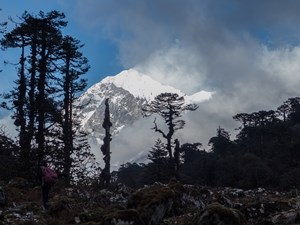
That’s great thanks. My group will be 5 for the monasteries trek and 4 for the Goecha La trek.
Post-Trek Feedback: Google Review
After completing both treks in November 2025, Jamie left this review:
Jamie Pasfield
I know it’s cliched to say it was the trip of a lifetime, but it was! The team was amazing and lovely, always making sure we were safe and very well fed. They were knowledgeable, highly professional and fantastically humble. And the views, landscape and nature were truly amazing. I doubt you could find a better way to do it.
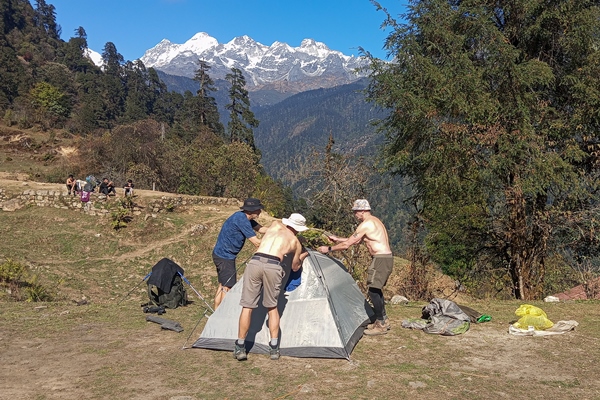
Feel free to connect to us to design your treks.



Comments