
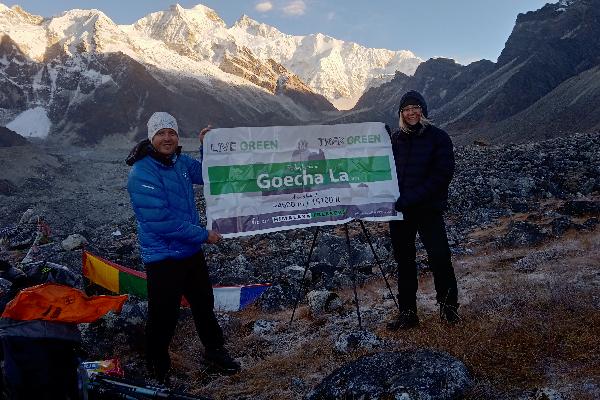
This guide explains how to walk the Goecha La trail inside Khangchendzonga National Park (KNP) on a semi‑independent basis. You still need to hire a registered local guide and secure all permits, entry tickets, and camping fees in advance; fully DIY trekking is not permitted for anyone.
Me and wife have been active in tourism for 8 years.
Our hiking arsenal includes the Greater Caucasus Range, the Altai Mountains, the Pamirs, and the Patаgonia Mountains. China, Spain, Portugal, Switzerland, OAE, Saudi Arabia, South Africa, Georgia, Turkey and Abkhazia.
Our dream of going to the mountains of the Himalayas has been living with us for several years.
And this spring, in the month of May, we will be with you.
The exact arrival dates at Delhi Airport are May 03 and May 17.Our goal during this time is to visit the pearl of the Indian Himalayas — Goechala Trek.
We always go without a band with full autonomous gear.
We always have our own tent and food.Please help us with the organization of the Goechala track.
We need a Guide and Porter for the duration of the entire trek.
We also need your help in obtaining all necessary permits and passes.I ask you to send me a commercial offer for my inquiries by return letter.
Thank you in advance for your reply.
Greetings of the day from India. Thank you very much for reaching out to us, HIMALAYA TREKKERS (HT). We really appreciate taking your time and writing all the details. You have very impressive trekking experiences and I hope this time Indian Himalayas will add to it 🙂
As you always trekked with your gear and food, we will provide you that opportunity as well as trekking independently as much as possible within the permitted rules. In this way you can feel the joy and freedom of engaging in such an activity.
You may already know that taking a guide is mandatory for the Goechala trail or anywhere inside the permitted national park areas or sanctuaries in Sikkim. So technically it is not possible to do a DIY trek inside KNP, e.g. Goehala.
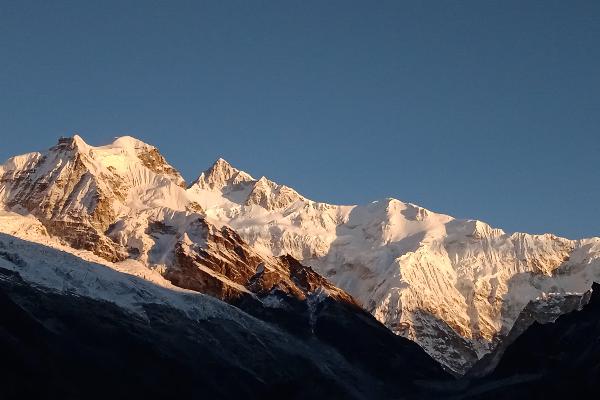
State of Sikkim has its own rules and permit formalities, especially inside the protected areas/national parks/sanctuaries etc.
Being surrounded by international borders, the rules and regulations for Indians and foreigners differ, as do the various charges, tickets, and levies collected by the forest department/national park authority, etc. Below is a breakdown:
Permits required:
RAP for foreigners only:
At first you will get a Restricted Area Permit/RAP same as Inner Line Permit (ILP) when you enter Sikkim via road (people who fly can get in at the airport). You will get it from the FRO (Foreigner’s Registration Office) situated at the major Sikkim -West Bengal border posts. You need to have two photocopies of your passport, Indian visa and 2 passport size photographs. This is free of cost and takes 15/20 minutes to get it on spot.
PAP for foreigners only:
Additionally Foreigners/OCIs need to be in a group of minimum two members or more applying for the permits together inside the national parks/sanctuaries etc. This particular permit is called Protected Area Permit/PAP or more commonly known as Trekking Permit. This permit can be processed only at Gangtok and we need to get it back at the trek base, which requires a full day.
Medical fitness certificate for ALL:
All trekkers are required to submit the medical fitness certificate at Yuksom police checkpost for the KNP clearance below. Usually your trekking agency will handle it. Here is our prescribed Medical Certificate format that works.
National Park entry, camping and other fees for ALL
Finally, there are per-day entry tickets, camping fees/tent pitching charges per night, cleaning and environmental levies, etc. inside the national park. You need to pay these at the KNP checkpost at Yuksom.
After obtaining all the above, and with a local guide, you can walk on the Goechala trail inside the Kanchendzongha National Park.
Suggested extended itinerary for Goechala trek:
I have added side trips on the Goechala trail and made it a total of 10 walking days. Please do a review. I have not given the Bikbari/HMI base camp option as that will require an additional camp at Bikbari.
Food from trekkers hut meaning that guide and porter will arrange their cooked food from Trekkers Hut.
Day 1: Enter Sikkim and get your RAP permitand reach Yuksom via Jorethang.. Night stay at Yuksom ~ 1710 m. Homestay/hotel choices. You may book one for yourself or we can book one such for you if need be.
Day 2: At Yuksom. Acclimatise and walk around Yuksom, Dubdi monastery etc. We process your PAP from Pelling/Gangtok and get it back to Yuksom.
Day 3: Trek to Bakhim (~ 2650 m) via Sachen approx 12 km, 5 to 6 hours.
Day 4: Short trek to Tshoka (~ 2960 m) – 3 km km, 2 hours. Tent. (Food from Trekkers Hut). There is a monastery and very small settlement at Tsokha so it’s worth a while to get acclimated around.
Day 5: Trek to Dzongri (~ 3965 m) via Phedang – 12 Km – 5/6 hours. Tent. (Food from Trekkers Hut). If the weather remains clear, visit Dzongri Top for sunset (approx 2 hours roundtrip). Early morning visit Dzongri top for sunrise views, return to Dzongri hut for breakfast. In the later half you can visit Lampokhari around Dzongri if you feel like. (4 hours round trip) or walk around.
Day 6: Side trip to Dzongri La (~ 4360 m) for a fantastic meadow walk and close views of Kabru and Forked peak and other peaks on the valley ahead. Then we will return to Dzongri. Tent. Food from Trekkers hut. Here is a possibility that we stay at Bikbari (beside Rathung Chu river) and visit the HMI base camp area and return. Further possibilities to Explore the alpine lakes of Bhaley Pokhari and Doodh Pokhari for Indian nationals only (foreigners including OCI are not allowed for these two lakes).
Day 7: Trek to Kokchurang, a beautiful camp beside the river. Tent. This day guide and cook may require some gas and stove from you to cook their food.
Day 8: Short trek from to Thangsing (~ 4100 m) 4 km – 2/3 hours. Tent (Food from Trekkers Hut).
Day 9: Start early in the morning by 2:30 to 3 am and trek to Samity lake and then to Goechala ViewPoint 1 (4600 m/15100 ft) for sunrise views – Approx 3 hours – Trek back to Lamuney and further down to Thangsing. Tent. (Food from Trekkers Hut)
Day 10: Side trip to Lampokhari (~ 4300 m on the ridge around) and back to Thansing, 5 to 6 hours round trip/hike. (Food from Trekkers Hut). WE can skip this if we camp at Bakbari and explore that side.
Day 11: Start from Thangsing and trek down to Kokchurang, from here to Phedang traverse and then further down to Tsokha. Approx 22 Km, 8 to 9 hours. Tent. (Food from Trekkers Hut)
Day 12: After breakfast start by 7/7:30 am and trek to Yuksom 15 km descent, 4 to 5 hours. Reach here by lunchtime (on your own, if you need so).
I hope I have not missed any side trips around. Please feel free to check all the possibilities around and let me know our thoughts. I will send a costing/estimated budget for the trek once we hear from you.
Good evening! Thank you very much for the detailed plan of our trip. You are a professional in your field, so I trust you. I am waiting for your estimate of the monetary expenses for the services of a guide, a porter, and any other expenses related to the organization of our trip. Thank you in advance!
Thank you for trusting us. That gives us some liberty on the itinerary. I would highly recommend that we focus on 10 trekking days. Our guide will assess the conditions and situations on the ground and will decide what maximum we can cover in those 10 trekking days in this Dzongri Goechala La area within the permits and rules.
Cost components
So let us break down the different costs and expenses involved for this trek.
1) Guide and a porter wage for 10 days and their food at high altitude as per the local diet. Approximate wage at present is ₹ (INR) 1500-2000/day for a basic English-speaking experienced local guide and ₹ 800/day for a porter.
They will get cooked food from available trekkers huts/kitchens at Bakhim, Tsokha, Dzongri, Thansing, and Kokchurang (approx. ₹ 1200-1500 per day). The cooked food available in the Trekkers Hut provided by the caretakers is expensive, even for a very simple meal. These are high-altitude huts, and prices are similar to what you get in Nepal tea houses. It is approximately INR 1200 per day if one takes all meals (B, L, D) from these huts.
One day they may have to carry some ready-to-eat cooked food if we camp at Bikbari. The porter and guide will arrange their stay in huts or in a tent if required (and will carry it). – A porter will carry 20 kg of your load. Their nominal entry tickets and any other levies, etc.
2) Protected Area Permit for 2 Foreigners, i.e., one of our peron/agent goes to Pelling or Gangtok and submits required documents, pays the permit charges/demand draft, and then the brings it to Yuksom. A physical copy is a must for a police verification at Yuksom and while purchasing Kanchendzonga National Park permits/entries.
3) Entry fees inside the national park on a per-day basis for foreigners (₹ 500/day) and 1 tent pitching charge per day (₹ 200/day), the same for the guide and porter (subsidised), and any cleaning charges or environmental levies, etc., for 10D/9N. – Total Approximate INR 15000 for 2 of you. You can directly at the Kanchendzonga National Park office at Yuksom in the morning before starting the trek. Stay inside Trekkers Hut is possible (although without any bedding or cot) and is charged at ₹ 2000/night/room.
4) Our tour operator service charges (as HT) and 5% of govt taxes will be charged for providing all necessary support and assistance for the trek. We will charge an additional ₹ 5000/foreigner for points 2 and 3 above, i.e., to process the PAP and to cover all permit and camping fees and charges inside KNP.
5) Two of your stay and food on the trek, and henceforth any cost, which in this case will be entirely self-supported by you.

Comments