

Not all trek grading systems mean the same thing. A “moderate” trek on one operator’s list might be an “easy” on another’s, or a genuine “difficult” depending on what factors they’ve considered. That inconsistency is what prompted HT to build its own grading framework – one based on seven measurable attributes rather than subjective labels.
Every trek in our catalogue is graded against the same seven criteria: total trekking duration (walking days), trail length in km, average daily walking hours, physicality on a 1 to 10 relative scale, maximum altitude reached, maximum altitude gain on a strenuous day, and trail character. Together, these give you a real picture of what the trek demands physically – not just a broad label.
We use following four tiers.
- Easy grade treks are suited to first-timers and families, with lower altitudes and gentler terrain.
- Moderate grade treks require a baseline fitness level and some prior trekking experience.
- Difficult treks are for trekkers with solid Himalayan experience and strong physical conditioning.
- Trekking Expeditions are a category apart – multi-week routes on technical, glaciated terrain above 5,000 m (16,400 ft), requiring prior high-altitude experience and specialist preparation.
Use the grade cateogry pages below to check the exact attribute thresholds for each tier, then match them honestly against your own fitness and experience.
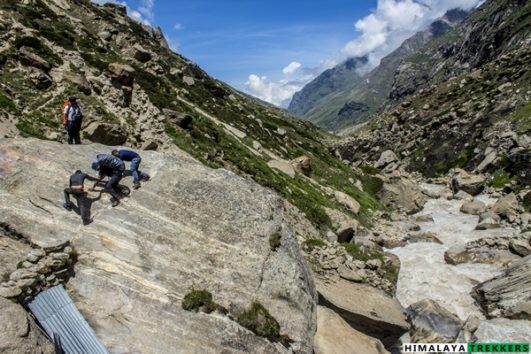
Difficult Treks
Check this list for your choice of “difficult or hard grade” treks in the Indian Himalayas.
Note:
- Ideally a person should consider attempting a hard trail having multiple prior high altitude experiences, preferably 4/5 times.
- S(he) must be having good physical fitness to sustain multiple days on high altitude.
We consider the following attributes to be qualified as a Difficult trek.”
- Trekking Duration: Should be between 8 to 15 days of walking.
- Trail Length: More than 80 Km and up to 150 Km.
- Trekking time per day: On an average 6/7 hours per day. There can be a be multiple days or back to back days of hiking for 10 hours or more.
- Physicality: Between 8/10 to 9.5/10 in a relative scale of 10.
- Altitude reaching : 4500 m to 6000 m ~ 20000 ft. Will involve multiple camps over 4000 m/13000 ft.
- Altitude gain per day: 1000-1200 m /3500-4000 ft in any strenuous day.
- Trail type: Defined or undefined trail with possible surprises. May require you to adapt or manoeuvre on tricky sections, especially on high altitude. The trail may contain walking on different type of terrains like boulders, scree, mud, snow, ice, moraine etc.
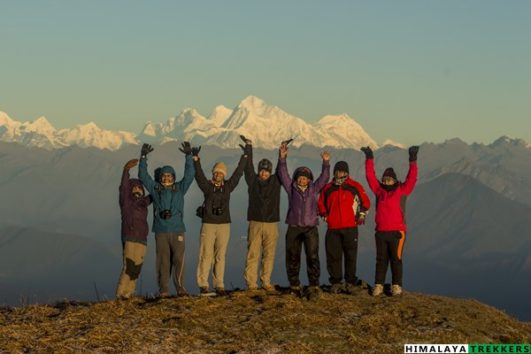
Easy Grade Treks in Himalayas
Check this list for your choice of “easy grade” treks in the Himalayas.
We consider the following attributes to classify a trek as ‘Easy trek.”
- Trekking Duration: Should not be more than 5 days of walking.
- Trail Length: Within 50 Km.
- Trekking time per day: On an average 5 hours per day. There can be a day of 3/4 hours walk and an odd day with 6/7 hours.
- Physicality: Up to 5.5/10 in relative scale.
- Maximum altitude: Within 13000 ft/4000 m.
- Altitude gain per day: Within 2000 ft/600 m per day. Rarely you may have to climb more.
- Trail type: Wide well defined trail. No tricks or manoeuvres required. It does NOT involve walking on different type of terrains like boulders, scree, mud, snow, ice, moraine etc.
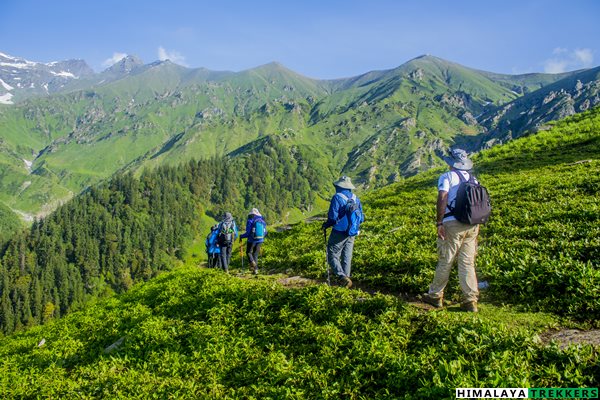
As per fitness required for easy treks, you must be having an active daily routine. Meaning, you should be comfortable walking 3 Km in 30 minutes with a load of 5/6 rucksack.
For your first Himalayan trek, these are the most suitable option. You will get choice of treks in Darjeeling/Sikkim, Uttarakhand, Himachal Pradesh and Kashmir/Ladakh. Many of these treks are equally charming even if you have done prior treks in the Himalayas.
Most of these treks require you to camp, i.e. to stay in tents. Few treks are Tea House or Homestay style treks where you will stay in small lodge/homestay accommodations.
We recommend some of these as family friendly treks, where you can take your kids as well.
Choosing right season for the trek is equally important. There is a trek for every season, be it spring/summer, fall/autumn, winter or even in monsoon.
Below is the list of Easy grade treks in Himalayas. Do check the upcoming treks schedule for which are already scheduled.
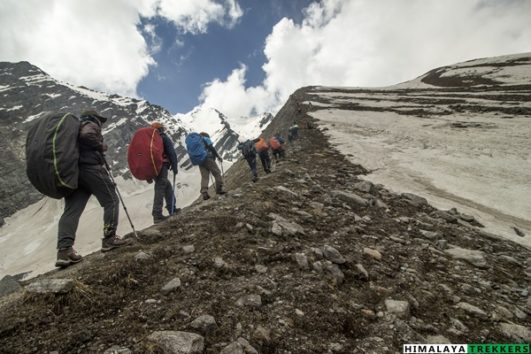
Moderate Grade Treks in Himalayas
Check this list for your choice of “moderate grade” treks in the Himalayas.
We consider the following attributes to classify a trek as ‘Moderate trek.”
- Trekking Duration: Should be between 5 to 8 days of walking.
- Trail Length: Within 80 Km.
- Trekking time per day: On an average 6/7 hours per day. There can be a day of 4/5 hours walk and an odd day with 8/10 hours.
- Physicality: Between 6/10 to 7.5/10 in relative scale.
- Maximum altitude: Within 16500 ft/5000 m.
- Altitude gain per day: Up to 3500 ft/1200 m per day on a strenuous day.
- Trail type: Defined trail with occasional surprises. May require you to adapt or manoeuvre on tricky sections. The trail may contain walking on different type of terrains like boulders, scree, mud, snow, ice, moraine etc.
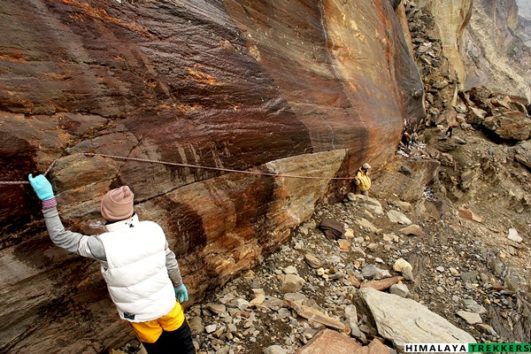
Trekking Expeditions
Trekking Expeditions sit beyond the standard Difficult grade. These are routes that involve sustained travel above 5,000 m (16,400 ft), often on glaciated terrain, with sections that require self-arrest awareness, moraine navigation, and the ability to manage extended days in thin air. They are not mountaineering expeditions in the technical climbing sense – but they are not standard treks either.
Setting up logistics is another major challenge and demanding task on these routes.
We mention a route as a Trekking Expedition when it meets the following thresholds:
- Trekking Duration: 10 days or more of actual walking.
- Trail Length: Typically 90 km and above.
- Trekking time per day: Averaging 7 to 10 hours, with multiple long summit or crossing days.
- Physicality: 9 or above. Sustained output over consecutive demanding days is required.
- Maximum altitude: Above 5,000 m (16,400 ft). Several routes cross passes above 5,500 m (18,045 ft).
- Altitude gain per day: Up to 1,500 m (4,920 ft) on key crossing days.
- Trail type: Glaciated sections, crevassed moraine, high-altitude snowfields, and unmarked terrain are all common. Route-finding experience or a technically confident guide is essential.
Who these treks are for:
You should have completed at least two Difficult grade Himalayan treks prior to attempting any expedition-grade route. General fitness is not enough – acclimatisation history, cold-weather camping experience, and mental resilience for multi-week remote travel all matter here.
Our website currently has five expedition routes (although we do customise many more): Kalindi Khal Trek (Gangotri), Auden’s Col Trek (Gangotri to Kedarnath), Panpatia Col Trek (Gangotri area), Kang Yatse 2 Peak (Ladakh), and Yunam Peak Expedition (Lahaul). Each has its own technical character – see individual trek pages for full route details.