

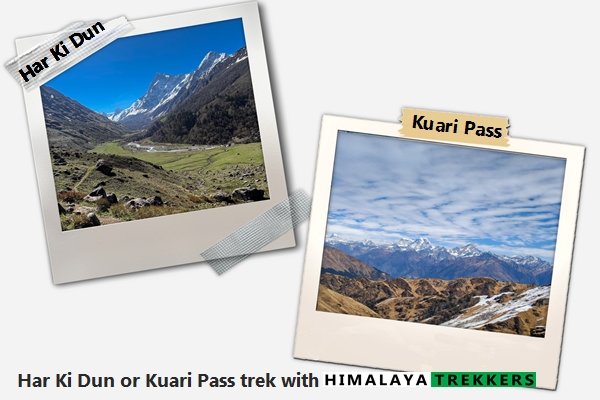
Har Ki Dun is a broad, river‑fed amphitheatre tucked deep inside the Govind Pashu Vihar sanctuary, while Kuari Pass is a windswept saddle above the tree line on Curzon’s historic trail overlooking a marquee skyline of Garhwal peaks inside Nandadevi Biosphere Reserve.
Both sit in Uttarakhand, promise snow underfoot in the colder months, and sit comfortably in the “first multi‑day Himalayan trek” bucket—yet they deliver very different pay‑offs in landscape, culture, effort, and ideal season. If you are torn between the two, the comparison below will surely help you choose between Har Ki Dun and Kuari that better fits your next adventure.
Quick‑glance Stats & Attributes
- When you’re short‑listing a trek, the first pass is always about hard logistics—how many trail days you’ll need, how high you’ll sleep, and which months actually make sense. Har Ki Dun clocks in at 6 days of walking, tops out at 3,500 m, and stays within an “easy” grade thanks to its gentle river‑valley profile.
- Winter Kuari Pass trims a day off the schedule but pushes a shade higher to 3,850 m and carries a moderate tag, largely because of its steeper summit day and colder bivouacs.
- Season windows differ too: HKD is open March–June and again September–November, while Kuari is a bona fide November–April snow trek.
| Attribute | Har Ki Dun | Kuari Pass |
|---|---|---|
| State | Uttarakhand | Uttarakhand |
| Base‑town | Sankri (1 ,950 m) | Joshimath (1 ,875 m) |
| Duration | 6 D / 5 N | 5 D / 4 N |
| Grade | Easy | Easy to Moderate |
| Physicality* | 5.5 / 10 | 6 / 10 |
| Max altitude | 3 ,500 m / 11 ,500 ft | 3 ,850 m / 12 ,630 ft |
| Trail length & Type | ≈ 35 km, Out and back | ≈ 25 km, Semi circuit |
| Season window | Mar–Jun (spring + summer) & Sep–Nov (autumn) | Mar to Jun (spring + summer) & Oct to Feb (autumn + winter) |
| Terrain snapshot | River‑valley meadows, remote villages, mixed forest | Oak–fir forest, wide meadows, high ridge |
| Signature peaks in view | Swargarohini, Black Peak, Bandarpunch | Nanda Devi, Hati Ghora, Dronagiri, Chaukhamba, Neelkanth |
Har Ki Dun vs Kuari Pass—When to Go
Early Spring (Mar–Apr)
- Har Ki Dun brims with residual winter snow without the permit ban of deep winter; blossom and bird activity return along the Supin Valley.
- Kuari Pass still offers consistent snow carpets on Khulara ridge, but temperatures can dip to –10 °C at camp.
Verdict: If you want gentler gradients and snow‑dusted forests, HKD wins; if you relish crisp alpine panoramas above cloud inversion, pick KP.
Summer (May–Jun)
- HKD Valley bursts into fresh jade‑green as snowmelt feeds terraces and rivers. Rhododendron, primula, and wild orchid patches light up clearings and areas around camps.
- Khulara & Gorson bugyals turn velvety‑green with summer blooms; early mornings give produce good views while smoke‑haze from occasional forest fires or heat can obstruct long-range peak views.
Verdict: Pick Har Ki Dun for riot‑green valley scenery and reliable floral displays; pick Kuari Pass if you want high‑meadow camping with warm days—just be ready for the odd smoky haze that can blur those famous Nanda Devi panoramas.
Post‑Monsoon Autumn (Oct–Nov)
- HKD explodes in walnut‑maple foliage and sees clear glacier views; the first light snows can add a frosting from late Oct.
- KP opens up blue‑sky vistas from October; snow usually starts late Nov, so Sep‑Oct trekkers trade snow for uninterrupted ridgeline views of the high peaks around, mirrored Nanda Devi reflections on Tali Lake.
Verdict: Colour lovers and photographers should head to HKD in mid‑Oct; peak‑baggers chasing the Garhwal “greatest‑hits” skyline are better served at KP.
Core Winter (Dec–Feb)
- HKD permits are typically suspended to minimise wildlife disturbance.
- KP, by contrast, becomes one of India’s designated “essential snow treks” and remains operational right through February (micro‑spikes mandatory).
Verdict: For a guaranteed snow holiday in peak winter, Kuari Pass is the practical—and legal—choice.
What Do You Value More? — Attractions Side‑by‑Side
Once the calendar math checks out, the real decision turns on pay‑offs that numbers can’t capture. Har Ki Dun is a broad, glacial amphitheatre fed by the Supin River, flanked by timber villages like Osla, and ringed by Swargarohini and Black Peak—a setting that trades mountaintop hero shots for a slow‑unfolding mix of forest layers, farm terraces, and valley sunsets.
Kuari Pass, by contrast, is a high ridge walk: oak‑fir woods give way to Khulara and Gurson bugyals, then a windswept saddle that frames a 200‑degree skyline from Dronagiri to Chaukhamba, with winter snow almost guaranteed from December through March.
So ask yourself: do you crave the botanic burst and village lore of a green river basin or the wide‑angle peak theatre and crisp snowfields of a Garhwal ridge? The side‑by‑side table that follows lays those qualitative trade‑offs bare so you can pick the trek whose scenery—and feel—matches your own idea of a Himalayan holiday.
| Factor | Har Ki Dun | Kuari Pass |
|---|---|---|
| Landscape character | Wide glacier‑cut valley framed by Swargarohini | Undulating oak–fir woods leading to a skyline pass |
| Village interaction | Stone‑and‑wood hamlets of Gangad & Osla | Brief stop‑overs in Joshimath/Auli, trek mostly wild |
| Forest & meadow | Mixed temperate forest; rhododendron & post‑monsoon blooms | Dense conifers at Tali; sweeping bugyals for snow play |
| Peak panorama | Swargarohini I–IV, Black Peak, Bandarpunch | Nanda Devi, Hathi Ghora, Dronagiri, Chaukhamba massif |
| Snow experience | Residual spring snow (Mar – early Apr), or early autumn snow in Nov | Reliable knee‑deep snow Dec – Mar, at times too much |
| Difficulty feel | Long but gradual; suitable for fit families | Steeper summit day; colder ridge nights |
Final Take—Which Trek Is “Better”?
Choose Har Ki Dun if…
- You want a gentle trek rich in village culture, forest diversity, and ever‑changing valley colours—especially brilliant in Oct – Nov.
- you prefer longer walking days over steep climbs, or you are trekking with children and first‑timers.
Choose Kuari Pass if…
- You crave uninterrupted big‑mountain vistas and a high‑pass “summit” feel without any extreme altitude.
- You’re chasing reliable snow between December and March, or you have limited time and want a 5 to 6‑day lodge‑camp circuit ex‑Joshimath.
Whichever trek path you pick, both routes are HT staples with years of on‑ground refinement. When dates firm up, check our latest fixed departures or drop us a line for a customised slot—then pack your rucksacks accordingly and let the season decide the story you’ll bring home :-).
Still undecided? Need finer details before deciding on which to take on? Feel free to reach us in a way that suits you better below:

Comments