

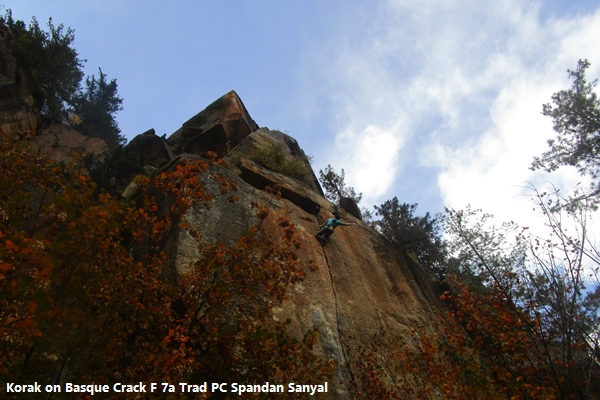
The Indian Himalaya offers a variety of alpinism objectives; most of them are high mountains at an elevation above 6000 m. Climbers from all over the world have come for these objectives, but the potential for technical rock climbing in alpine settings and on alpine walls is huge. Over the past few decades, dedicated teams have explored and established numerous climbing routes of such style. These routes are testimonial to the development of modern rock climbing. Routes of such styles are established on peaks and walls that are not very high, mostly below 6000 m, sometimes on lower 6000ers, in different parts of the Indian Himalaya.
In this article, we take a look at two such places in the Indian Himalaya region, namely, the Zanskar and Pensi La region and Rakchham, and will try to provide an overview of such routes that have been established in these areas.
Zanskar and Pensi La Region, Suru Valley
The Zanskar region, locally known as Zangskar, is a remote and isolated sub-district of the Kargil district in the Indian union territory of Ladakh. It is a high-altitude semi-desert nestled on the northern flank of the Great Himalayan Range.
Zanskar lies in the south-western part of the Kargil district of Ladakh. It is situated between the Great Himalayan Range to the southwest and the Zanskar Range to the northeast.
The Kargil-Padum road begins at Kargil, a major town in Ladakh, and ends at Padum in the Zanskar Valley. The road primarily traverses the Suru Valley and the Zanskar Valley.
Pensi La (also known as Penzi La) is a high mountain pass situated at an elevation of approximately 4,400 metres (14,436 feet) on the Kargil-Padum road. It serves as a crucial link between the Suru Valley (west) and the remote Zanskar Valley (east), earning it the nickname “Gateway to Zanskar“.
Pensi La serves as a watershed between two contrasting landscapes: Suru Valley, greener, with alpine meadows and villages, and Zanskar Valley, an arid, high-altitude cold desert with limited vegetation.
On the Suru side, meltwaters flow into the Suru system, which originates from the Panzella Glacier (west of Pensi La, in Suru Valley), flows northwest through the fertile Suru Valley, and eventually joins the Indus River near Kargil. On the Suru side, Rangdum (a small settlement with a gompa) sits in a wide glacial valley.
Here in this region, some fantastic rock climbs have been done on really good quality granite.
In 2014, a team of Spanish climbers and alpinists explored and climbed in the area and established several new routes. They were based at 3,900 m in the Shafat Valley, a side valley of the Suru and home to the Shafat Fortress (see AAJ 2008).
Here they climbed established routes on Golden Sentinel (ca 5,200 m) and Punta Georgio (ca 5,135 m), put up by Italians (AAJ 2006 and 2009). Later, they established Aguja Tunlup via the route Sangui (500m, 6c), then climbed Aguja Pomo Yan Le (ca 5,000m) by the route Tasio i es Desgraciats (500m, 6c).
After these routes, the team climbed a pillar leading to the east summit of Shafat Fortress, naming the route Incertidumbre (700 m, 6b A0 55° snow). They found excellent hand cracks just where they needed them.
After 20 days at this base camp, they used horses to transfer all their equipment to the other side of the river, installing a Tyrolean to make things easier. The next days they climbed two new routes: Superestetico Espolon and Mas Arrogante, Desplomada y Ordesina on the Pilares de la Tierra (600 m, 7a A0; 500 m, 6b). They also climbed a rock route at the entrance of the valley leading up to Nun Kun: 700 m, mainly 6a but with a section of 6c.
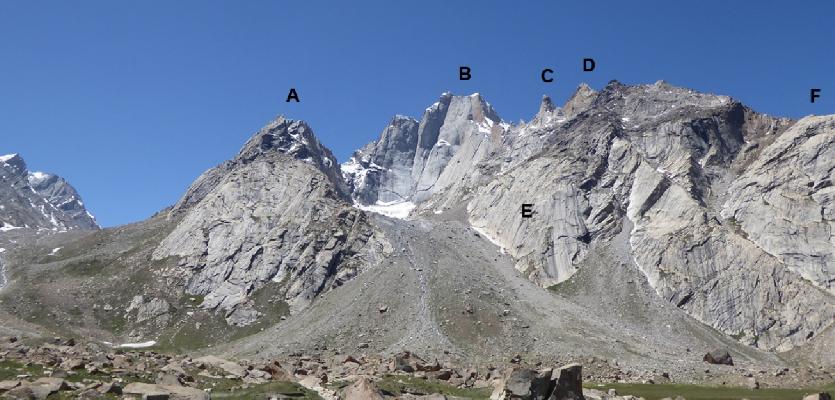
Figure 1: A general view of the Shafat Valley. (A) Tunlup. (B) Shafat Fortress. (C) Punta Giorgio. (D) Golden Sentinel. (E) The Spanish party climbed two routes on this slabby buttress. (F) This 700m slabby formation was climbed and dubbed the Chessboard by Italians in 2007.
In August 2022, Tasio Martin and Marc Toralles made the first ascent of a 5,700 m peak. This peak lies at 34° 00′ 17″ N, 76° 11′ 42″ E in a small side valley that runs west into the Shafat and is a southern outlier of Shafat Peak (5,900 m). Immediately north of Shafat Peak and at a lower altitude is the well-known Shafat Fortress. Their new route, Txoria Txori
(740 m of climbing, 7a+), climbed over 17 pitches with difficulties up to 7a+ and multiple pitches in 6c+, and was climbed entirely clean, using only nuts and cams for protection
The southwest face of Punta Guillem Aparicio with the line of the 17-pitch Txoria Txori. A rappel descent was made on the wall to the left to avoid the approach couloir.
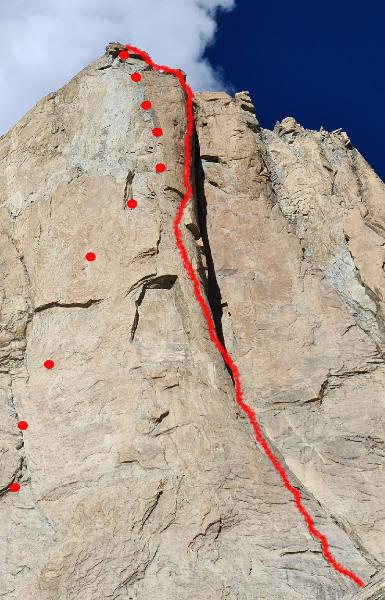
Figure 2: The southwest face of Punta Guillem Aparicio with the line of the 17-pitch Txoria Txori. A rappel descent was made on the wall to the left to avoid the approach couloir.
Ahead, up towards the way to Pensi La in the remote La Lung valley, a new rock route was established in 2017 by an Indian team (Spandan Sanyal and Korak Sanyal). The new route was established on the northwest-facing granite buttress of the 5,200 m peak, located southeast of their base camp.
The route Mahalaya climbs a 550 m line on the central section of the buttress with crux difficulty at 6a+ or UIAA VI+. The route was climbed using only clean removable protection and in a single onsight push.
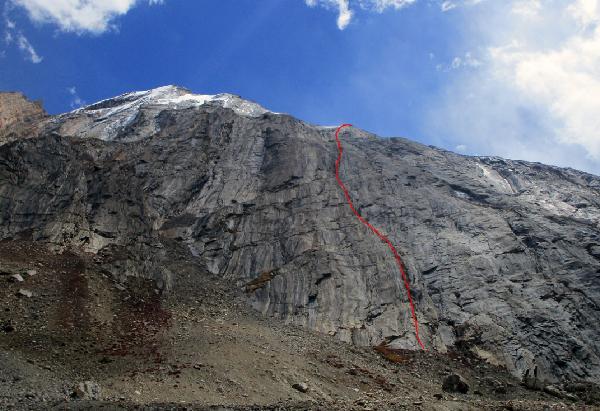
In 2024, a Slovenian women’s expedition team established a connection at VI – 1400 metres on the same buttress, with two other easier routes.
There is still much potential for new routes on quality granite in these areas, and they also offer excellent alpine climbing objectives.
On the Zanskar side, Pensi La opens into the upper Zanskar basin, with vast barren plateaus and braided rivers.
Zanskar has a cold desert climate, with extremely harsh winters and mild, dry summers. The Great Himalayan Range acts as a barrier, protecting the region from the monsoon. This allows the months of July, August, and September (which are generally monsoons in the Indian Himalaya) to be a perfect season for climbing and mountaineering activity.
The main Doda river valley (Zanskar valley) runs from Darung-Drung glacier near Pensi La in the southeast direction towards Padum, where, after confluence with the Tsarap river, they form the Zanskar river, a tributary of the Indus river. Along the river is the main Kargil–Padum road, which passes the villages of Akshow, Abran, Kushol, Phey, and Tungri. Southwest of the Doda River is the Great Himalayan Range; there are many valleys originating from it and converging to Zanskar. Some of them are (from north to south): Haskira Tokpo, Kange Tokpo, Hangshu Nala, Panding Tokpo, Bakarsei Tokpo, Denyai Tokpo, Mulung Tokpo, Shimling Tokpo, Rangtik Tokpo, Haptal Tokpo, Chhogo Tokpo, and Gompe Tokpo. All these valleys are surrounded by many peaks. The altitude of the peaks varies from 5200 m to 6400 m. Local Ladakhi people (and early explorers) use some of the valleys for connection with Kisthwar in the south. The main “trekking” passes are Muni La at the head of Haptal Tokpo, Umasi La at the head of Mulung Tokpo, and Hagshu La at the head of Hangshu Nala. Most “popular” for climbing is Hangshu Nala with the famous and beautiful peak Hagshu (6515 m). All the other less-frequented travelled valleys are starting to get attention from climbers, and their popularity has been increasing in recent years. In 2009, Spanish climber Sergi Ricart, who spent several months in Ladakh and Zanskar, also visited the Haptal area and reported in AAJ. At that time, he visited Rangtik Tokpo and Kange Tokpo. In 2012, a Japanese senior expedition (led by Kimikazu Sakamoto) explored the area. They reported on their activity and also made a better mapping of the area and improved identification of many peaks.
Over the years, the activity in these valleys has resulted in really diverse, high-quality alpine rock climbs at elevations between 5000 metres and 6000 metres. The areas here hold a lot of potential new route opportunities. Below is the summary of some of the classic lines that have been established in the area in the recent past.
The most attractive rock climbs are mainly in Rangtik Tokpo. This valley and the surrounding areas to the south of the Doda River are infrequently visited by mountaineers. Summits rise to around 6,400 m, but in terms of scale, the ridges and faces are more like those of the Alps, and there is great potential for amazing climbs at all grades. Approaches from villages along the Kargil-Padum road are not long; most mountains can be reached in one day. The established base camp in the Rangtik Valley is at 4,926 m (33° 28′ 30″ N, 76° 45′ 13″ E).
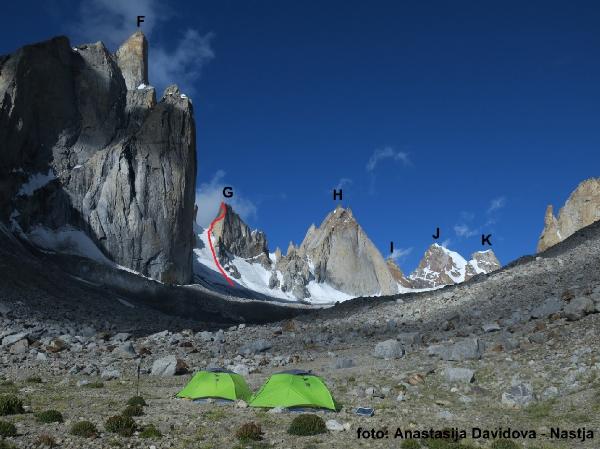
Figure 4: Base camp site in Rangtik Tokpo (GPS: 33°28’30” North, 76° 45′ 13 East, 4926 m) and mountains on the south side of Rangtik glacier. F is Phobrang (5800 m), later named as Jamyang Ri, G is Shawa Kangri (GPS: 5728 m, 33°27’46 North, 76°44’07” East), H is P6085 m (aka H2), I is P5680 m, J is P6095 m, and K is P6005 m. The route of the first ascent of Shawa Kangri is marked in red. The first ascent of the peak was made on 16th August 2008 by Spanish climbers Luc Pellissa and Sergi Ricart. They named their approximately 500 m high route “Rolling Stones” and graded it D+, ice 65°, rock UIAA V+. They also named the peak itself. The summit block looks like a horn, so they named it Shawa (Shawa means horn in the Ladakhi language).
In 2017, an Austrian team made the first ascent of a new route on the southwest face of Jamyang Ri (5800 metres). Dust – From Dusk till Dawn, 500 metres, 6b A1
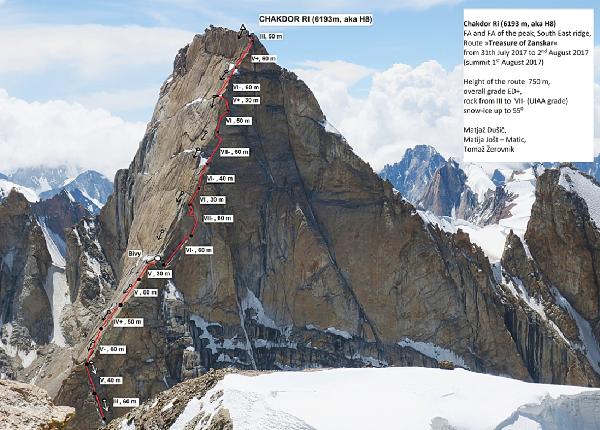
In the same year, a Slovenian team made the first ascent of the peak Chakdor RI (6193 metres, a.k.a. H8) via a route they climbed on the southeast ridge of the mountain. They named their route Treasure of Zanskar 750 metres ED+, with rock from III to VII- and an approach with snow and ice up to 55 degrees.
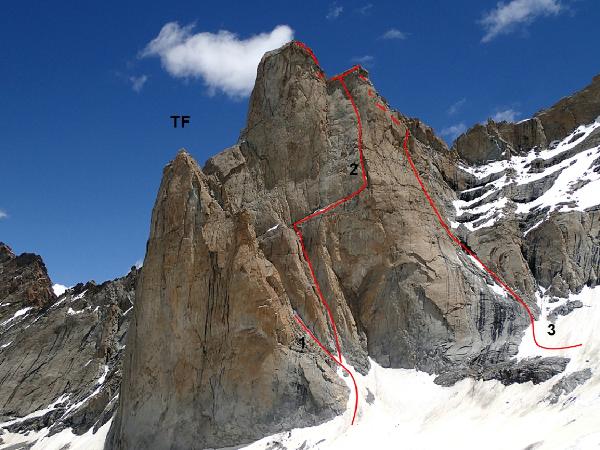
In July 2023, a team of Italian climbers made some beautiful new routes in the Rangtik Tokpo. Markus Ranalter and Elisabeth Lardschneider climbed Norbu Duk Lam, on Little Jamyang Ri’s northeast face (560 m of climbing, 18 pitches, VIII A1).
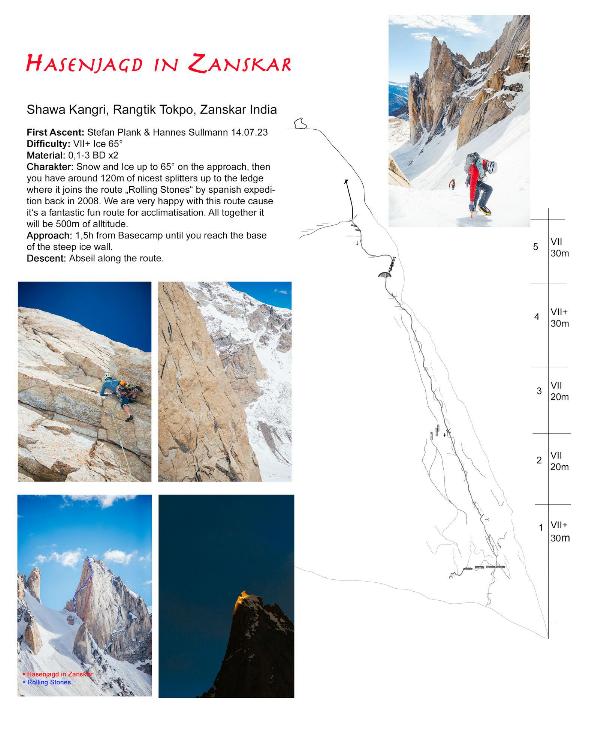
Stefan Plank and Hannes Sullmann made the first ascent of Hasenjagd in Zanskar in Shawa Kangri. The route approaches with 65 degrees of snow/ice and then climbs 120 m up to VII+ to join the 2008 Spanish route Rolling Stones and is about 500 metres in total length.
The Rangtik Tokpo has some incredible rock and offers possible futuristic projects for the upcoming generations. This area offers the chance to modern alpinists, who are looking for technical rock challenges to be tackled in lightweight alpine style.
Rakchham in Sangla valley Himachal Pradesh
Rakchham is located in the Sangla Valley, 11 km before Chitkul, on the banks of the Baspa River. It has emerged as a popular tourist destination over the last 10 years and has become an attractive place on the Kinnaur-Spiti circuit for adventurous and enthusiastic tourists.
Rakchham offers some of the best granite climbing in the world. This place offers all the different forms of rock climbing of the very highest quality; the boulders, cliffs, and bigger walls provide ample opportunity for the intrepid climber to create lines of great quality and difficulty.
In a previous article, we delved deeper into the great climbing the valley has to offer. Here, we will provide an overview of the best alpine rock climbs that stand out.
The best alpine rock climbs in the valley lie above Rakchham village. A short approach leads to the Chongor, a very sacred place for the villagers. Here, in many of the granite walls surrounding the plateau, many high-quality routes have been established.
In the year 2019, an international team of climbers consisting of Siebe Vanhee, Jacopo Larcher, and the Pou brothers came to Rakchham and established high-quality rock climbs in the area.
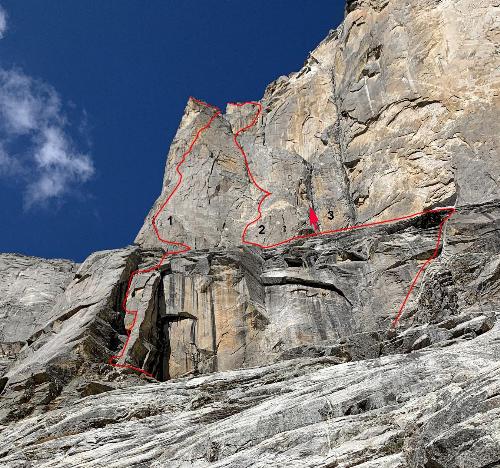
Particularly the Pou Brothers put some classic FAs in the Chongor Region. Eneko and Iker Pou (Spain) first climbed a previously unclimbed peak of 4,670 m, which the brothers named Midi d’Ossau after the famous Pyrenean mountain. They summited this via a route named the Latin Brother (560 m, 7c+, 12 h), referring to Hansjörg Auer, with whom they shared two of their best expeditions, to Baffin Island and Siberia. The second route led to an unnamed summit of around 5,000 m, to the north of Midi d’Ossau. The Spanish route climbed an elegant and spectacular ridge and was named Miquellink (600m, 6b, in 12h), dedicated to the Mallorcan climber, Miquel Riera, who is generally credited with having “invented” deep water soloing and died while the brothers were in India.
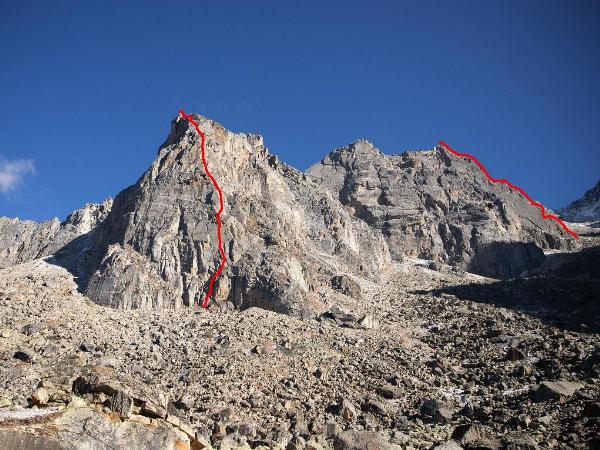
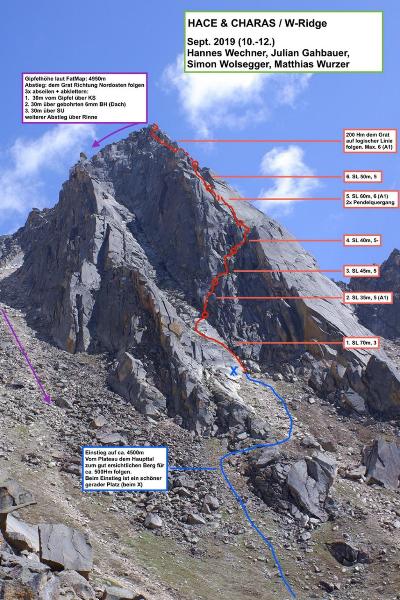
In the year 2019, a young Austrian alpinist team put up Hace and Charas (4,850 m) via the north flank and west ridge. This gave a 450m route of UIAA VI A1. Descent was by down-climbing the northeast ridge with three rappels.
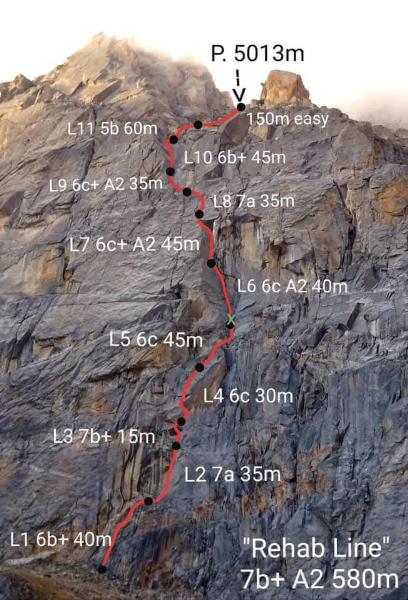
In the same year, another Austrian team, including Gebi Bendler & Christophe Schranz, Markus Karle, Roman Mayerl, & Magnus Stang climbed a few new routes. The most striking is up the south face of an unnamed granite peak of approximately 5,000 m on the west side of the valley. We named the summit Alpbandariol (31°25’46.98″N, 78°22’22.68″E) and the route Rehab Line, climbing it clean but not all free (580 m of climbing, 7b A2). They estimated the route can be climbed completely free at around 8a. They descended east in the couloir behind the peak to rejoin the valley.
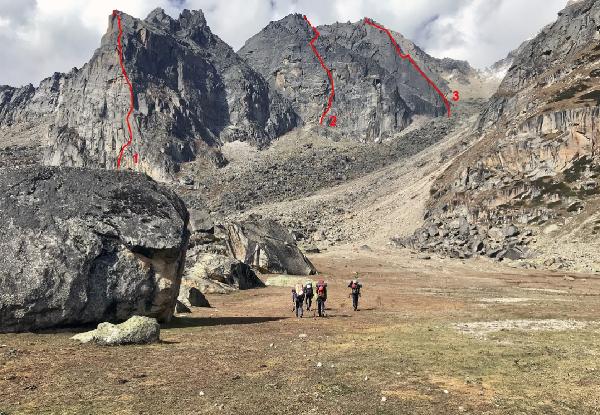
Figure 10: Looking north-northeast across the Rakchham Plateau. (1) Approximate lines of Latin Brother (560m of climbing, 7c+, Spanish, 2019); (2) Rehab Line (580m of climbing, 7b A2, Austrians, 2019); and (3) Miquellink (600m of climbing, 6b, Spanish, 2019).
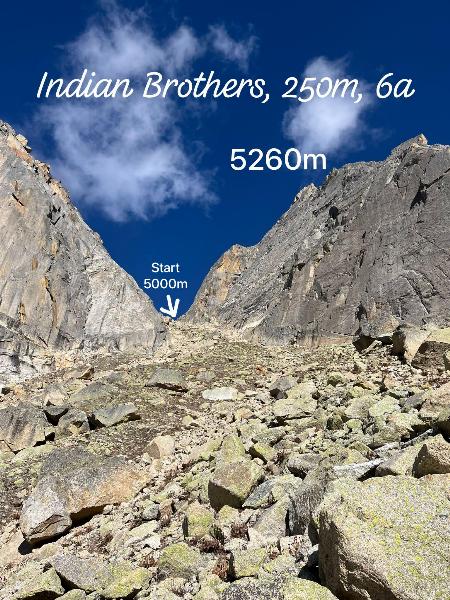
In 2024, a team comprising Christophe Ogier (France), Alberto Urtasun (Spain), and we, Spandan and Korak Sanyal from India climbed in the Chongor Area, where the team put up Indian Brothers 250 m 6a (FA by Chris and Alberto) on a 5260-meter summit. Later, the team attempted a new line on the same wall, where the line Latin Brothers exists, but had to bail after climbing 250 metres, up to difficulty 6a A1 (obligatory) 7a (max).
Other than Chongor, the nearby Raldang Massif has seen some remarkable ascents on that spectacular big wall.
In 2010, Silvia Vidal climbed a new route up the southern flank of Raldang (5499 metres) solo over 25 days. She named her route Naufragi 6a+, A4+, 1050 metres, finishing at the top of the wall at 5250 metres.
In 2019, a team led by Much Mayer and an international team comprising Siebe Vanhee and Jacopo Larcher climbed two new free routes on Raldang Spire, on the lower left side of the face.
The Austrians named their route Babaji 500 metres, 17 pitches, 7b. The international team chose a line over to the right of this line and avoided the first steep part of the pillar (approximately five pitches) by coming in from the right and then continuing up a prominent dihedral. The climb is Toby’s Shipwreck (450 m, 7b).
Below is a detailed article on rock climbing and bouldering opportunities in Rakchham.
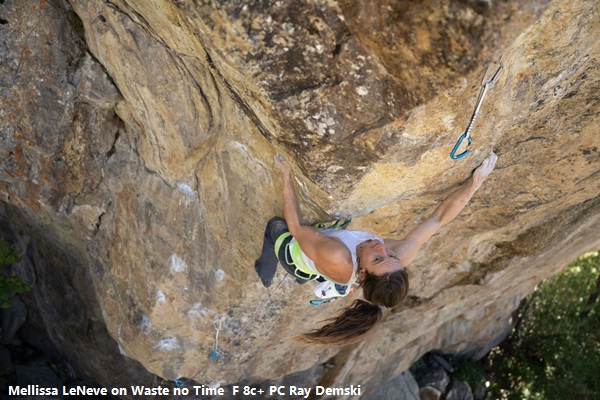
Rakchham has become one of the top destinations in the world for rock climbers and alpinists alike. Apart from the cragging and bouldering, it offers an amazing wealth of granite formations in surrounding valleys, which will provide ample potential for high-quality alpine rock routes.
Sources
American Alpine Journal articles by the climbers of these new routes, Much Mayer, Iker and Eneko Pou, Christophe Schranz and others.
Let’s explore and climb the Indian Himalayas together. Feel free to connect via:


Comments