

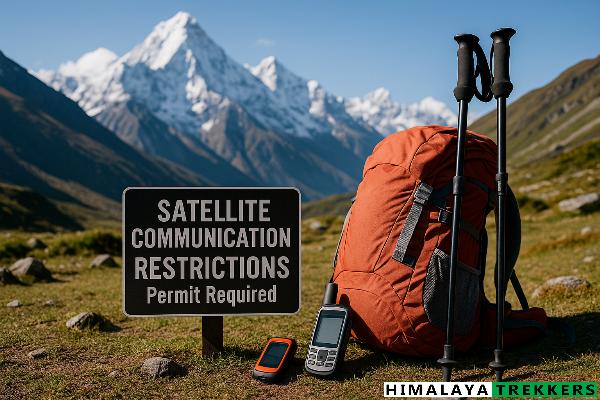
Short answer: Bringing or using satellite phones (Iridium/Thuraya/Inmarsat) or two-way satellite communicators (e.g., Garmin inReach, SPOT, Iridium GO!) in India without prior permission from the Department of Telecommunications (DoT) is illegal. Customs can seize devices on arrival. Trekkers should plan on not carrying these devices.
Also read: All-in-One Guide to Trekking Permits in the Indian Himalayas (Hub)
Legal basics: why satcom is restricted
Customs rule at airports
Customs Circular 37/2010 requires passengers to declare satellite phones on arrival; clearance is granted only on producing DoT permission. Undeclared/unauthorised devices are liable to seizure and the holder to penalty/prosecution under the Telegraph/Wireless laws.
Who can offer satcom in India (GMPCS)
Only operators authorised under DoT’s GMPCS licence may provide satellite mobile services in India. Consumer use of handheld satphones/two-way satellite messengers requires alignment with this licensing—bringing foreign-service devices and using them in India without permission is illegal.
Border belts & high-sensitivity zones
In Himalayan border districts, enforcement is zero-tolerance. Security agencies treat unauthorised satcom devices as a threat; expect check-post scrutiny and confiscation if found.
What counts as satcom vs what’s fine to carry
- Prohibited without DoT permission: Handheld satphones (Thuraya, Iridium, Inmarsat IsatPhone), two-way satellite communicators (Garmin inReach family, SPOT, Iridium GO!). These devices transmit to satellites.
- Generally OK: Receive-only GPS navigators (e.g., Garmin eTrex/GPSMAP non-“i” models) and phone offline maps. India’s import policy explicitly classifies GPS/DGPS receivers as “Free.”
Plain English: a Garmin GPS receiver is fine; a Garmin inReach (satellite messenger) is not fine without a DoT licence/permission.
Common devices & trekker mapping (allowed vs. not allowed)
| Device type | Examples (popular models) | Status for trekkers | Reason / note |
|---|---|---|---|
| Handheld satellite phone | Iridium 9575/9555, Inmarsat IsatPhone 2, Thuraya XT-LITE | Not allowed without DoT permission; declare if carried | Customs requires DoT approval; unauthorized possession/use attracts action under Telegraph/Wireless laws. |
| Two-way satellite communicator | Garmin inReach Mini 2 / Messenger / 67i, SPOT Gen4 / X, Iridium GO! | Not allowed without DoT permission | Transmits to satellites (GMPCS/MSS regime); treated as satellite mobile service devices. |
| Receive-only GPS handheld | Garmin eTrex 32x, GPSMAP 65/66/67 (non “i”) | Allowed | Receive-only GNSS; DGFT classifies GPS/DGPS receivers as “Free” for import/use. |
Practical alternatives for trek safety
- Carry a SIM that has decent coverage in the area you are visitng (check with your organiser or guide) and keep and power backups.
- File your route/ETAs with the organiser; check in at park/district posts on regulated trails.
- For mission-critical communications, consult the district administration well in advance; tourist approvals for satcom are rare.
Annexure — Official links
- CBIC Customs Circular 37/2010 — declaration & release only with DoT permission: PDF
- Chennai Customs — Passenger FAQ (satphones need DoT licence; Telegraph Act penalties): Official FAQ
- DoT — GMPCS (satellite mobile) licensing (who can offer satcom in India): Service page
- DGFT Import Policy (GPS/DGPS) — GPS receivers listed as “Free”: Policy table (HS 8526)
- Embassy advisories (Govt of India missions) — “Don’t carry satellite phones without DoT permission”: Brussels | Harare



Comments